
Functional Mushrooms: Should you be eating more of them?
Learn about how these fascinating fungi may boost your brain power, reduce stress, promote better immune function, and more.

If you feel like mushrooms are showing up more often on ingredient labels, you’re not imagining it. From supplements and snacks to coffee alternatives, alcohol replacements, and everything in between, these fungi are quickly becoming mainstream ingredients. In fact, the functional mushroom market is projected to be worth nearly $66 billion by 2030.[1]
However, these aren’t the type of mushrooms you add to your favorite stir-fry; they’re better known for their potential to support brain health, immunity, energy, and more. Because of that, they’re often referred to as “functional mushrooms.”
But are these claims legitimate? Can adding more of these mushrooms to your diet (or supplement routine) really help you think more clearly, feel better, or boost your immunity? We answer these questions, break down the science, and explain it all in this guide.
What are functional mushrooms?
Functional mushrooms (also known as medicinal or adaptogenic mushrooms) are species of mushrooms containing naturally occurring bioactive compounds that may support your health and wellness in a variety of ways.[2] [3]
Although interest in these fungi has only recently surged, functional mushrooms have been used as treatments in traditional medicine — such as Ayurveda and traditional Chinese medicine — for centuries.[4] [5] [6] Even Ötzi the Iceman had medicinal mushrooms in his bag. (The Iceman is a 5,300-year-old, well-preserved mummy discovered in the Alps in 1991.)[7]
Currently, research suggests functional mushrooms may promote better brain function, immune defense, stress resilience, and energy, among other things. However, it’s important to clarify that not all mushrooms are “functional” ones.
Some functional fungi you’re most likely to come across include:[2]
- Lion’s mane (Hericium erinaceus)
- Reishi (Ganoderma lucidum)
- Chaga (Inonotus obliquus)
- Cordyceps (Ophiocordyceps sinensis or Cordyceps sinensis)
- Turkey tail (Trametes versicolor)
How do functional mushrooms work?
Functional mushrooms contain a wealth of bioactive compounds — beta-glucans, dietary fiber, polysaccharides, triterpenes, phenolic compounds, and sterols — that interact with different systems in the body. Although researchers haven’t completely decoded how functional mushrooms work, their active components display a wide range of potential benefits, including (but not limited to) anticancer, antioxidant, antidiabetic, antiobesity, and immunomodulatory effects.[2]
- Lion’s mane: May enhance neuroprotection, boost cognitive function, reduce oxidative stress, stimulate nerve growth factor (NGF), and more[8]
- Reishi: Often used to support immune system functioning and blood sugar control[9]
- Chaga: May reduce inflammation, lower blood sugar, and promote heart health[10]
- Cordyceps: May improve athletic performance and immunity[11]
- Turkey tail: Mostly used for gut health, but may also improve neuroprotection and immune function[12]
How to fit more functional mushrooms into your daily regimen
You can definitely increase your intake of functional mushrooms by adding them to your diet, especially when cooking. They’re nutrient-rich and can enhance the flavor of your meals. Unfortunately, to achieve the doses of functional mushrooms used in many studies, you’d need to eat them often and in fairly large amounts. That’s where supplements come in.
Whether you prefer capsules, powders, or ready-to-drink options, functional mushroom supplementation can be a convenient way to get just the right amount of active compounds to support your wellness goals — as long as that particular supplement uses research-supported doses, that is.
Choosing the best functional mushroom supplement
The market for functional mushroom products has grown exponentially in recent years, and it doesn’t seem to be slowing down anytime soon.[1]
Functional mushroom extracts versus whole powders
If a supplement uses a functional mushroom powder, that simply means the mushroom — either the whole thing or certain parts — has been ground up and added to the supplement. While some may argue that this means you’re getting everything the mushroom has to offer, this option isn’t as great as it sounds.
- Lower-than-ideal dosing: Studies often use large doses (e.g., one or more grams), which are difficult to fit into capsules.
- Potency: Functional mushroom extracts are far more potent, meaning you’re more likely to get a dose comparable to what’s used in studies.
- Absorption: Mushrooms have tough cell walls that the human body can’t easily digest; the extraction process “releases” beneficial compounds for easier absorption.[13]
Additionally, when choosing a functional mushroom supplement, check whether it lists the extraction ratio or specifies whether it uses the fruiting body, mycelium, or whole mushroom. For example, if a supplement contains 100mg of a 20:1 lion’s mane fruiting body extract, that dose (equivalent to 2g of lion’s mane fruiting bodies) has research-backed support to promote better cognition.[15] [22]
What ingredients pair well with functional mushrooms?
Since research indicates that functional mushrooms have adaptogenic and nootropic properties, combining them with other well-dosed ingredients that have similar potential may enhance these benefits.[14] [15]
For example, if you’re looking for a cordyceps supplement to support your athletic performance, you may want a product that pairs it with well-dosed ingredients like tart cherry or turmeric.[16] [17] Alternatively, you may want a supplement that combines reishi and berberine for blood sugar support.[18]
The bottom line
Functional mushrooms — lion’s mane, cordyceps, reishi, chaga, turkey tail, and others — have been used for centuries as traditional medicine treatments. More recent research has shown that they hold considerable potential in promoting a wide range of health and wellness benefits.
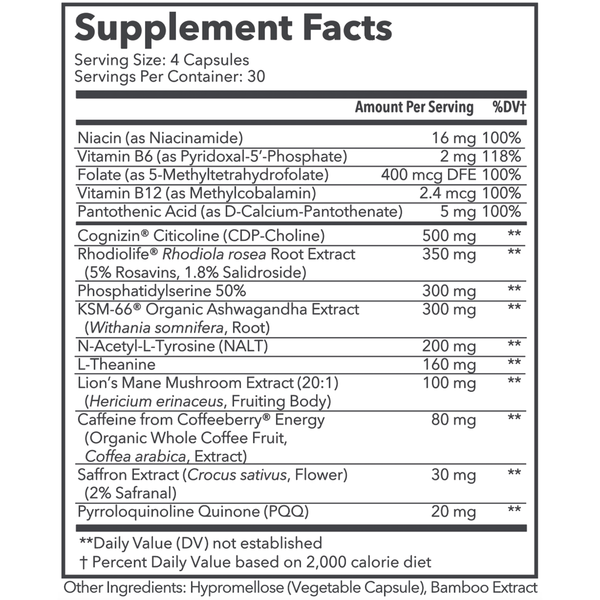
Based on your goals, it can be a good idea to choose a supplement that combines your preferred functional mushroom with well-dosed supportive ingredients. For example, if you want a lion’s mane supplement for focus, cognition, and mood support, then pairing it with research-supported amounts of ashwagandha[19], L-theanine[20], and citicoline[21] could be just what you need.
Innerbody Labs Focus Support contains these exact ingredients, along with several other beneficial inclusions, in clinically tested doses like that 100mg of a 20:1 lion’s mane extract to support your brain health, focus, mood, and cognitive functioning.



29 Reviews
Focus Support
$99.00