
L-Theanine: What It Does, How It Balances Caffeine, and Where to Find It
The science behind tea’s calm clarity — and the amino acid that makes it happen.

Have you ever noticed that drinking tea can be a different experience from drinking coffee — less jittery, perhaps? That might not just be in your imagination. Research points to L-theanine, an amino acid found in tea, as one reason. It can help promote calm focus, balance caffeine’s stimulation, and support better sleep.[1]
While tea offers small amounts of L-theanine naturally, studies suggest that higher doses — the kind used in clinical research — can deliver more noticeable benefits. In this article, we explore what L-theanine is, how it works, and the best ways to get enough of it throughout your day.
What is L-theanine?
L-theanine is a naturally occurring amino acid found mainly in the leaves of the tea plant (Camellia sinensis) and, in smaller amounts, in a few types of mushrooms.[1] It’s one of the compounds that gives tea its distinctive chemical profile, influencing both its flavor and its physiological effects.
Most amino acids are used to build proteins in the body. L-theanine is different. It circulates freely in the bloodstream and can cross the blood-brain barrier, the tightly regulated membrane that controls which substances enter the brain from the blood. This ability allows L-theanine to reach neural tissue directly, where it interacts with key chemical messengers involved in mood and cognition.[2]
How L-theanine works
L-theanine’s structure is similar to that of glutamate, a neurotransmitter that helps drive learning, memory, and attention by exciting neurons.[46] Because of that similarity, L-theanine can interact with some of the same receptors in the brain, but it doesn’t activate them as strongly. Instead, it subtly modulates their activity, helping to prevent excessive stimulation. Researchers believe this ability to balance excitatory signaling may explain why L-theanine has a calming influence without causing drowsiness.[3]
Beyond this glutamate connection, L-theanine also interacts with several other neurotransmitters — particularly those that shape mood and attention, including:[1] [4]
-
Dopamine, linked to motivation and focus
-
Serotonin, involved in mood balance and sleep regulation
- GABA, which helps regulate relaxation and stress response
By slightly increasing or stabilizing these signaling pathways, L-theanine appears to support balanced neural activity rather than stimulating or sedating the brain.[1]
Electroencephalography (EEG) studies support this picture. EEG is a noninvasive method for recording the brain’s electrical activity, capturing rhythmic patterns called brain waves. In controlled trials, participants who consumed L-theanine showed increases in alpha-wave activity, the same rhythm seen during relaxed wakefulness or quiet focus.[5] This pattern suggests that the brain remains alert but not overstimulated, engaged without shifting into a high-stress, “fight-or-flight” state.
That mechanism may help explain why the mental effects of tea often feel steadier than those of coffee, even though both contain caffeine.
How L-theanine balances caffeine
Most people know caffeine for what it does best — sharpening alertness by blocking adenosine, a neurotransmitter that makes you feel drowsy.[6] That blockade raises levels of other brain chemicals, like dopamine and norepinephrine, which increase energy and focus.[7] But for some, that stimulation can go too far, bringing restlessness, jitters, or even a mild spike in heart rate.[8]
That’s where L-theanine comes in. Research suggests it can temper caffeine’s overstimulation by acting on complementary pathways in the brain.[9] Instead of blocking adenosine, L-theanine promotes alpha-wave activity and supports inhibitory neurotransmitters such as GABA and serotonin, helping to stabilize neural activity even as caffeine increases arousal.[1] [2]
So, in combination, caffeine and L-theanine complement one another: caffeine heightens alertness by increasing excitatory signaling, while L-theanine modulates that activity to maintain calm, consistent attention.[13] The result is what researchers describe as “relaxed wakefulness” — a state of steady, improved focus without sedation or overstimulation.[10] Indeed, studies show that taking caffeine and L-theanine together can: [11] [12] [13]
- Improve reaction time and attention accuracy compared to caffeine alone
- Enhance subjective alertness without increasing jitteriness or anxiety
- Reduce mental fatigue during demanding cognitive tasks
Benefits of L-theanine
While much of L-theanine’s appeal comes from how it balances caffeine, its benefits don’t end there. Decades of clinical and preclinical research suggest that this amino acid supports the brain and body in several other ways, many of which overlap with the known effects of tea itself.
Below are some of the most studied areas of potential benefit.
Stress and anxiety
L-theanine’s best-documented effect is its ability to reduce both subjective stress and physiological stress responses. Controlled trials show that doses around 200mg can lower heart rate and stress hormones during cognitive or social stress tasks. In one Japanese study, participants who took L-theanine performed better on attention and fluency tests under pressure compared with placebo.[14]
Larger reviews of trials using 200-400mg/day report consistent decreases in self-reported anxiety and measurable improvements in task performance, reaction time, and alpha brain-wave activity.[15] These findings suggest that L-theanine helps the brain maintain composure and cognitive performance during stress rather than acting as a sedative at rest.
Sleep
L-theanine’s potential to improve sleep appears closely tied to its calming influence on the nervous system. EEG studies show increases in alpha-wave activity within 40 minutes of ingestion at doses between 50mg and 200mg, a brain-wave pattern linked to relaxed wakefulness.[16] A systematic review found that daily doses from 50mg to 655mg improved sleep onset, total sleep time, sleep efficiency, and next-day alertness.[17]
Unlike sedatives, L-theanine doesn’t induce sleep directly; instead, it seems to make it easier to fall asleep by reducing stress-related activation. This may be especially useful for people whose minds stay active at bedtime.
Cognitive and neurological health
Animal studies show that L-theanine can cross the blood-brain barrier, allowing it to reach brain regions involved in attention, learning, and memory.[18] [19] Once there, it appears to influence electrical activity and neurotransmitters linked to focus, motivation, and mental clarity.
Human studies support those effects functionally. With L-theanine either alone or combined with caffeine, they report improvements in recognition and recall among adults with mild cognitive impairment at doses as low as 60mg/day, and better attention and reaction time at 200mg/day.[13] [20] [21] These results suggest that L-theanine may help sustain concentration and cognitive performance, particularly under mental strain.
Longevity
While human data remains limited, animal studies have linked L-theanine supplementation to modest increases in both average and maximum lifespan.[22] The mechanism may involve reductions in oxidative stress, which contributes to cellular aging. Observational studies of tea drinkers also show slower biological aging among those with consistent tea intake, though tea’s other bioactive compounds likely play a role as well.[23]
Although the research is still early, the existing evidence offers reason for optimism: by helping protect cells from oxidative stress, L-theanine may support the same biological pathways tied to healthy aging.
Blood flow and circulation
L-theanine may also have mild cardiovascular benefits. Research suggests it increases nitric oxide production, a molecule that relaxes blood vessel walls and promotes healthy circulation.[24] This can lead to small but meaningful reductions in blood pressure in some individuals.[25]
Because caffeine can transiently raise blood pressure, L-theanine’s balancing effect may be one reason tea produces a steadier physiological response than coffee. Though these changes are subtle, they may contribute to overall cardiovascular resilience.
Natural sources of L-theanine — and their limits
The vast majority of dietary L-theanine comes from tea. It’s synthesized in the roots of the tea plant (Camellia sinensis) and transported to the leaves, where it contributes to tea’s distinct umami flavor.[2] It’s also found in trace amounts in a few edible mushrooms, such as Xerocomus badius (the bay bolete), but tea is where most people get it.[16]
How much L-theanine is in tea?
The amount of L-theanine in tea depends on the variety, how it’s grown, and how it’s prepared. Shade-grown teas such as matcha and gyokuro tend to contain more because lower light levels encourage amino-acid formation in the leaves, while the oxidation that turns leaves into black tea slightly reduces it.[26] [27]
On average, an 8oz of tea provides:[28] [29]
-
Green tea: about 8-20mg of L-theanine
-
Black tea: roughly 20-30mg
- Matcha or gyokuro: around 40-50mg per serving, since the powdered leaf is consumed rather than steeped
Those amounts are enough to shape tea’s calming character but fall short of the 100-400mg daily doses typically used in clinical research on stress, focus, and sleep.[13] [15] [21]
Why the difference matters
While tea provides L-theanine naturally alongside caffeine and polyphenols, the variability between types, brands, and brewing methods makes it hard to achieve consistent levels.[28] You’d need to drink several cups — sometimes five to ten per day — to match the amounts used in most clinical research.[1] [2] [13] [15] [21]
For those who enjoy tea, these smaller doses can still contribute to a sense of calm focus, especially when spread throughout the day. But for experiencing L-theanine’s full potential — improving sleep quality, managing stress, or enhancing cognitive performance — supplemental L-theanine offers the same molecule at reliably higher concentrations.
That’s where the next section comes in: how to use L-theanine supplements safely and effectively to reach research-backed levels.
How to start supplementing with L-theanine
Because it’s hard to get enough L-theanine from tea alone, supplements can be a convenient way to match the amounts tested in research. Most studies showing clear effects on stress, focus, or sleep use 100-400mg per day, often divided into one or two servings.
Choosing the right form
Not all theanine is created equal. Chemically, the compound exists in two mirror-image forms: L-theanine and D-theanine. The L-form occurs naturally in tea and can also be made synthetically, while the D-form is strictly synthetic. Research suggests that D-theanine behaves very differently in the body — it’s less bioavailable, breaks down more quickly, and doesn’t appear to provide the same benefits as L-theanine.[30] [31] [32]
Because L-theanine makes up only about 1-3% of dried tea leaves, extracting it from tea would be prohibitively expensive.[16] That’s why most manufacturers rely on synthetic production. The catch is that this process typically yields a 50/50 mixture of L- and D-theanine unless the manufacturer takes extra steps to separate the two.[33] Evidence indicates that D-theanine may actually dampen L-theanine’s effects, so supplements containing both could deliver less benefit than expected.[32]
For best results, look for products that specify 100% L-theanine and, ideally, provide a certificate of analysis (COA) or third-party verification confirming purity. These steps ensure you’re getting the same form of theanine found naturally in tea.
Finding your goal-based dose
The best dose of L-theanine depends on what you hope to get from it — whether that’s calm focus during the day or more restful sleep at night. Human studies show clear benefits in the 100-400mg daily range, typically divided between one or two servings.[1] [2] [13] [15] [21]
-
For focus or balance with caffeine: When taken with caffeine — usually in a 2:1 ratio of L-theanine to caffeine — doses of 100-200mg can sharpen attention and working memory while reducing the jitteriness or tension caffeine sometimes causes.[9] This pairing is one reason many people describe tea’s stimulation as smoother and steadier than coffee’s.
-
For relaxation or better sleep: A single dose of about 200mg in the evening has been shown to lower stress markers, promote relaxation, and support restorative sleep quality.[17] In EEG and sleep-tracking studies, this amount increases alpha-wave activity and shortens the time it takes to fall asleep without causing next-day grogginess.[16]
- For managing ongoing or high-stress conditions: Research suggests that total daily doses of 200-400 mg may offer stronger reductions in perceived stress and physiological stress markers than lower amounts.[15] The evidence points to a dose-dependent relationship, with higher intakes producing more consistent benefits in people under sustained pressure.
Why complex formulas can help
L-theanine on its own can support calm focus and better sleep — but pairing it with the right nutrients can make those effects stronger and more consistent. That’s the thinking behind two of our signature formulas at Innerbody Labs, which combine research-backed doses of L-theanine with complementary compounds that amplify its benefits.
Focus Support
If your main goal is sharper concentration and steady mental energy, Focus Support delivers L-theanine in one of its most effective combinations — alongside a moderate dose of caffeine and a suite of nootropics and adaptogens chosen to enhance focus and stress resilience. Each serving includes 160mg of L-theanine and 80mg of caffeine, a well-documented 2:1 ratio shown in human studies to improve attention and working memory while reducing caffeine-related jitters.[9] [10] [11] [12] [13]
That foundation is reinforced by a blend of clinically researched ingredients for cognitive support:
-
Citicoline to boost acetylcholine activity and support memory and focus[34]
-
Rhodiola rosea to enhance resilience and cognitive performance under stress[35]
-
Ashwagandha to lower cortisol and promote calm, sustained focus[36]
-
Saffron and lion’s mane to support mood, motivation, and long-term brain health[37] [38]
- B-vitamin complex to help maintain healthy homocysteine levels and overall cognitive function[39]
The result is a comprehensive formula containing 15 science-backed nootropic ingredients, each supported by research for its potential to improve cognition, focus, mood, and stress response.
Sleep Support
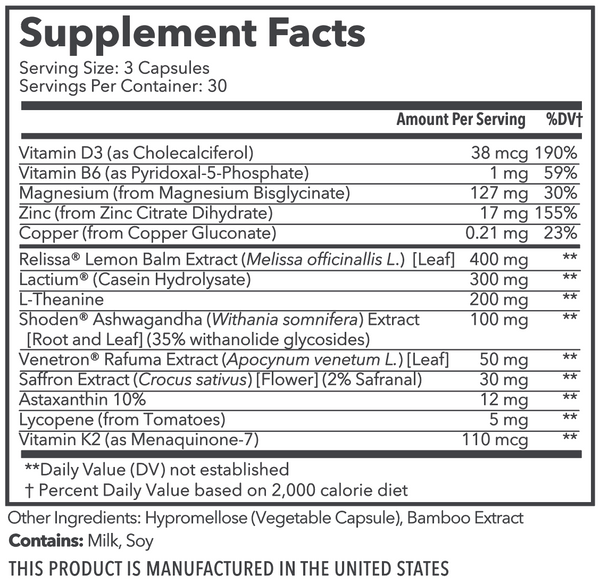
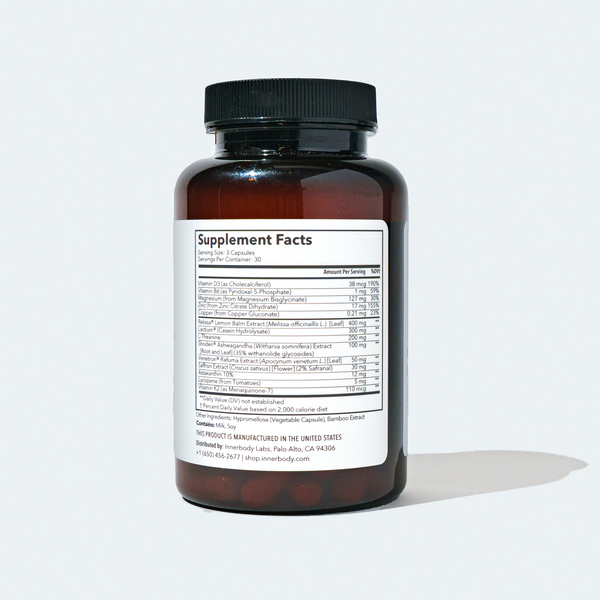
When stress or poor sleep quality are the main challenges, Sleep Support combines L-theanine with complementary nutrients designed to calm the nervous system and restore healthy rest without sedation. Each serving provides 200mg of L-theanine — the same dose shown in clinical studies to improve relaxation and sleep quality — alongside other well-studied ingredients that address multiple pathways involved in stress and sleep regulation, some of which are:[17]
-
Casein hydrolysate to help you fall asleep faster and stay asleep longer by improving sleep efficiency[40]
-
Magnesium bisglycinate to relax muscles, ease tension, and support deeper, more restorative sleep[41]
-
Ashwagandha extract to reduce stress and support natural cortisol balance for better sleep quality[42]
-
Saffron extract to promote restful sleep and improve next-day mood[38] [43]
- Lemon balm extract to calm the nervous system and reduce anxiety before bed[44]
By combining these ingredients, Sleep Support may enhance and extend L-theanine’s own benefits. Research shows that L-theanine and casein hydrolysate together improve total sleep score, latency, duration, and overall sleep efficiency, while animal studies suggest that pairing L-theanine with magnesium amplifies its calming effects on the nervous system.[45] [46]
Together, these nutrients help quiet the mind and body — without sedation or next-morning grogginess — for more restful nights and wakeful days.
Pairing Focus and Sleep Support for all-day balance
For the best results, many people use both formulas as part of a daily routine — Focus Support in the morning and Sleep Support at night. The doses align to provide maximum benefit from shared ingredients like L-theanine, saffron, and ashwagandha, while their complementary nutrients target different sides of the stress cycle.[1] [36] [42] [43]
Used together, they create a balanced rhythm of alert focus by day and restorative sleep at night — a simple, evidence-based way to support calm energy and recovery around the clock.
How to make L-theanine work for you
Supplementing with L-theanine offers a science-backed way to achieve the calm focus that tea drinkers have enjoyed for centuries — but at the doses research shows work best. While your daily cup of green tea provides some L-theanine naturally, supplements can deliver the 100-400mg amounts that studies link to measurable improvements in stress, sleep, and cognitive performance.[1] [2]
Whether you’re looking to balance caffeine’s stimulation, wind down more easily at night, or maintain steady focus during demanding tasks, L-theanine appears to support the brain’s natural ability to stay alert without overstimulation. The key is choosing pure L-theanine (not the synthetic D-form) and finding the right dose for your goals — typically 200mg for relaxation and sleep, or 100-200mg when paired with caffeine for focused energy.[9] [16] [17]
As with any supplement, consistency matters more than perfection. Start with lower doses to assess your response, and consider how L-theanine fits into your broader wellness routine. The research suggests it’s both safe and effective for daily use — a simple way to bring more balance to your mental energy throughout the day.


48 Reviews
Sleep Support
$65.00