
PQQ: What it is, and what it can do for you
This naturally occurring coenzyme plays important roles in creating new mitochondria and boosting brain power.

For many of us past a certain age, every year takes from us a little more of our physical health and mental faculties. We get tired faster and find it harder to focus or remember things. Fortunately, we can slow this gradual decline, not only by exercising the body and mind but also by taking in important nutrients that keep our systems running as they should.
One of those nutrients is pyrroloquinoline quinone, or PQQ.
What is PQQ?
To explain what PQQ is, we should take a step back and define some terms necessary to take in the whole picture. Terms like:
-
Enzyme: a very small type of molecule that starts and accelerates chemical reactions in the body
-
Cofactor: a chemical compound necessary for an enzyme to do what it does
- Oxidative stress: when your body has more unstable, harmful molecules called free radicals than it does protective molecules called antioxidants
With all that in mind, when we say that PQQ is an enzyme cofactor, you can understand that it’s an essential component for your body’s biochemistry. Specifically, your enzymes use PQQ to initiate chemical reactions against oxidative stress, which is linked to age-related physical and cognitive declines.[1] [2] PQQ’s antioxidant quality has earned it its informal classification as a “longevity vitamin” (though it’s technically not a vitamin, more just vitamin-like).[3]
At the same time, PQQ provides key support to mitochondria, which generate most of the body’s cellular energy. It both vitalizes existing mitochondria and helps create new ones.[4] The resulting increase in cellular energy promotes healthier aging and sharper brain function.[5] [6]
What can PQQ do for you?
Scientific research gives us at least two good reasons to want some PQQ in our lives.
One is that its antioxidant action might help fight the signs of aging. For example, a 2024 study on mice showed that PQQ can activate a protein that may prevent an age-related degenerative spinal condition called intervertebral disk degeneration (IVDD).[7] Another recent mouse study had similar outcomes with regard to muscular atrophy, muscle inflammation, and skin aging.[8] Although these were animal studies, their findings point to PQQ’s potential to slow the rate of physical changes that accompany aging.
But if it’s human studies you want, you can look to any one of these placebo-controlled trials of PQQ’s effects on cognitive function:
-
In 2016, subjects who received daily doses of PQQ had significantly increased blood flow to the prefrontal cortex, a brain region that regulates working, spatial, and long-term memory (to say the least).[9] [10] The increase in the brain’s blood supply suggests enhanced brain activity.[11]
-
In 2020, a trial intended to examine PQQ’s effects on physical endurance instead found that it increased a protein called PGC-1α.[12] Higher levels of PGC-1α are associated with improvements in cases of cognitive impairment.[13]
-
In 2021, people aged 40-80 who received PQQ over 12 weeks demonstrated significant improvements in numerous cognitive measures, including composite memory, verbal memory, complex attention, cognitive flexibility, and executive function.[14]
- And in 2024, elderly participants with mild cognitive impairment demonstrated increases in BDNF, a molecule associated with the ability to grow and maintain neuronal connections.[15] [16] That means PQQ might help you not only with learning new information but also with retaining the information you already know.
Sources of PQQ
PQQ is naturally present in a lot of common foods and drinks (including some surprising ones). Here’s a nonexhaustive list:[17]
-
Fermented soybeans: 61ng per gram
-
Parsley: 34.2ng per gram
-
Green tea: 29.6ng per milliliter
-
Green pepper: 28.2ng per gram
-
Kiwis: 27.4ng per gram
-
Papayas: 26.7ng per gram
-
Tofu: 24.4ng per gram
-
Spinach: 21.9ng per gram
-
Broad beans: 17ng per gram
-
Potatoes: 16.6ng per gram
-
Sweet potatoes: 13.3ng per gram
-
Bananas: 12.6ng per gram
-
Whiskey: 7.93ng per milliliter
- Wine: 5.79ng per milliliter
But look closely at the quantity of PQQ per measure of food or beverage. We’re dealing with nanograms, which are one-billionth of a gram. To put it in perspective: a serving of natto, the most PQQ-rich food on this list, is 50g of total food, and so it contains just around 3,050ng (0.003mg) of PQQ. You would need to eat nearly 330 servings, or approximately 36lbs, of natto before you consumed even 1mg of PQQ. That’s equal to more than 120,000 calories’ worth of pungent, slimy soybeans. All for just a fraction of the PQQ used in successful clinical studies.
Meanwhile, it takes a lot of PQQ to approach toxic levels. In rats, a toxic amount ranges from 500mg to 2,000mg per kilogram of body weight.[25] For a human who weighs around 175lbs, an equivalent dose would be 6,450mg to 25,800mg. So there’s a huge gap between unsafe doses and the feasibly attainable quantities of PQQ you can get from diet alone.
How much PQQ do you need?
Successful human studies on PQQ’s cognitive and mitochondrial effects typically have used 20mg doses, or thereabouts.[18] That’s well below potentially toxic quantities. And with dietary sources providing only trace amounts, you’re going to need a PQQ supplement to get you to the needed quantity.
Keep in mind, not all PQQ supplements provide the ideal dose. In fact, you’ll find that many brands have just 10mg of PQQ. That’s possibly effective, according to one study, but much less validated by clinical research overall.[18] When scoping the market, you’d do well to center your search on stronger formulations.
Also, you might want to see about incorporating other supplements to optimize PQQ’s best-supported health effects. We mean ingredients like ashwagandha, L-theanine, and saffron, which share PQQ’s ability to vitalize mitochondria and improve cognitive functions.[19] [20] [21] [22] [23] [24]
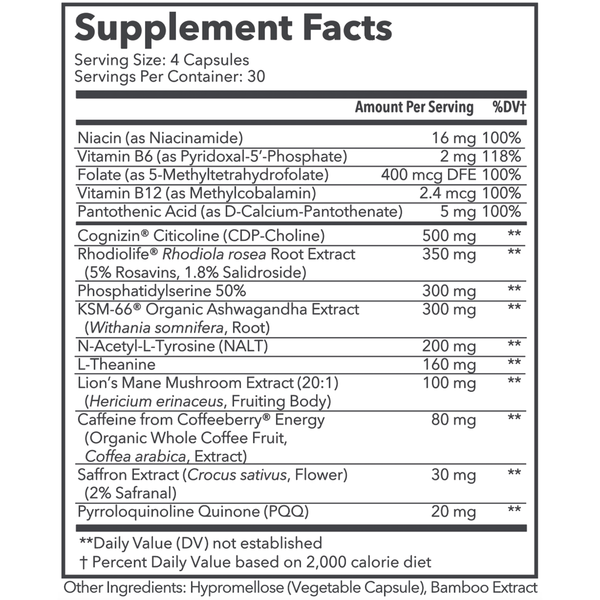
And you don’t need to go stocking your cabinet with armsful of bottles from the health aisle, either. A single supplement, Innerbody Labs Focus Support, combines 13 well-studied cognitive-enhancing ingredients all in doses used successfully in clinical research — including 20mg PQQ, 300mg KSM-66 ashwagandha, 160mg L-theanine, and 30mg saffron. A four-capsule daily serving is all you need to reap the advantages of PQQ and other nootropics, so you can think and concentrate more keenly day-to-day.



35 Reviews
Focus Support
$99.00